
Heat Recovery Ventilation Systems Ireland
Design, supply, installation and commissioning of residential heat recovery ventilation by Healthy Homes. From new-build plans to suitable retrofit projects, we help homeowners, builders, architects and developers plan an MVHR system around the property.
Request a Heat Recovery Ventilation QuoteWhat Is Heat Recovery Ventilation?
Heat recovery ventilation, commonly known as MVHR (Mechanical Ventilation with Heat Recovery), is a whole-house ventilation system that continuously removes stale and humid air while supplying fresh filtered air. A heat exchanger recovers heat from outgoing air and transfers it to incoming fresh air without mixing the two air streams.
For a more detailed explanation, read our guide to what MVHR is and how it works. This page focuses on planning and installing a system for your project.
How Does a Heat Recovery Ventilation System Work?
Two fans move air through separate supply and extract paths. Incoming outdoor air is filtered and passes through the heat exchanger before being distributed through supply ducts. Stale indoor air returns through extract ducts, gives up heat in the exchanger and is exhausted outdoors. Heat recovery depends on the unit, airflow and operating conditions.
Fresh air supply
Outside fresh air
Outdoor intake
MVHR unit / heat exchanger
Filtered air receives recovered heat
Fresh filtered supply air
Supply ductwork
Bedrooms / living areas
Supply terminals
Stale air extract
Bathrooms / kitchen / utility
Extract terminals
Stale extract air
Extract ductwork
MVHR heat exchanger
Outgoing air transfers heat, not air
Exhaust outside
Separate outdoor exhaust
Heat passes across the exchanger between separate channels. The supply and extract air streams do not mix. Air moves between living areas and wet rooms through planned transfer paths, such as suitable door gaps. This schematic shows airflow, not a property-specific duct design.
What Rooms Are Supplied and Extracted?
Fresh air supply: normally bedrooms, living rooms and other habitable spaces. Room terminals and airflow rates are selected as part of the individual ventilation design.
Stale air extract: normally bathrooms, kitchens, utility rooms and WCs. Planned transfer paths allow air to move from habitable rooms towards wet rooms.
Benefits of Heat Recovery Ventilation
Continuous, controlled ventilation
A planned supply and extract airflow throughout the home, with boost operation for periods of higher demand.
Moisture and stale air removal
Extract ventilation in wet rooms helps manage moisture and remove stale air at source. It does not resolve every cause of damp.
Filtered incoming air
Outdoor air passes through filters before reaching living spaces. Filter specification and regular maintenance affect performance.
Recovery of otherwise wasted heat
The exchanger uses warmth from outgoing air to temper incoming air, reducing ventilation heat losses without replacing heating.
Heat Recovery Ventilation for New Builds
Planning whole house heat recovery ventilation during design and construction gives space to coordinate duct routes, unit position, room terminals and commissioning requirements. It also allows service access, noise control, outdoor intake and exhaust locations and the airtightness strategy to be considered before work is closed up.
Send your floor plans and project stage through our ventilation project enquiry form so we can discuss the proposed installation.
Can Heat Recovery Ventilation Be Retrofitted?
MVHR can suit some existing homes, but not every retrofit. Airtightness, building layout, available duct routes and ceiling or attic space all influence suitability. Routing ducts through finished areas may add disruption and making-good work.
An assessment should establish whether a heat recovery system is appropriate or whether another approach offers a better fit. Compare our residential ventilation services before deciding.
Professional MVHR Design & Installation
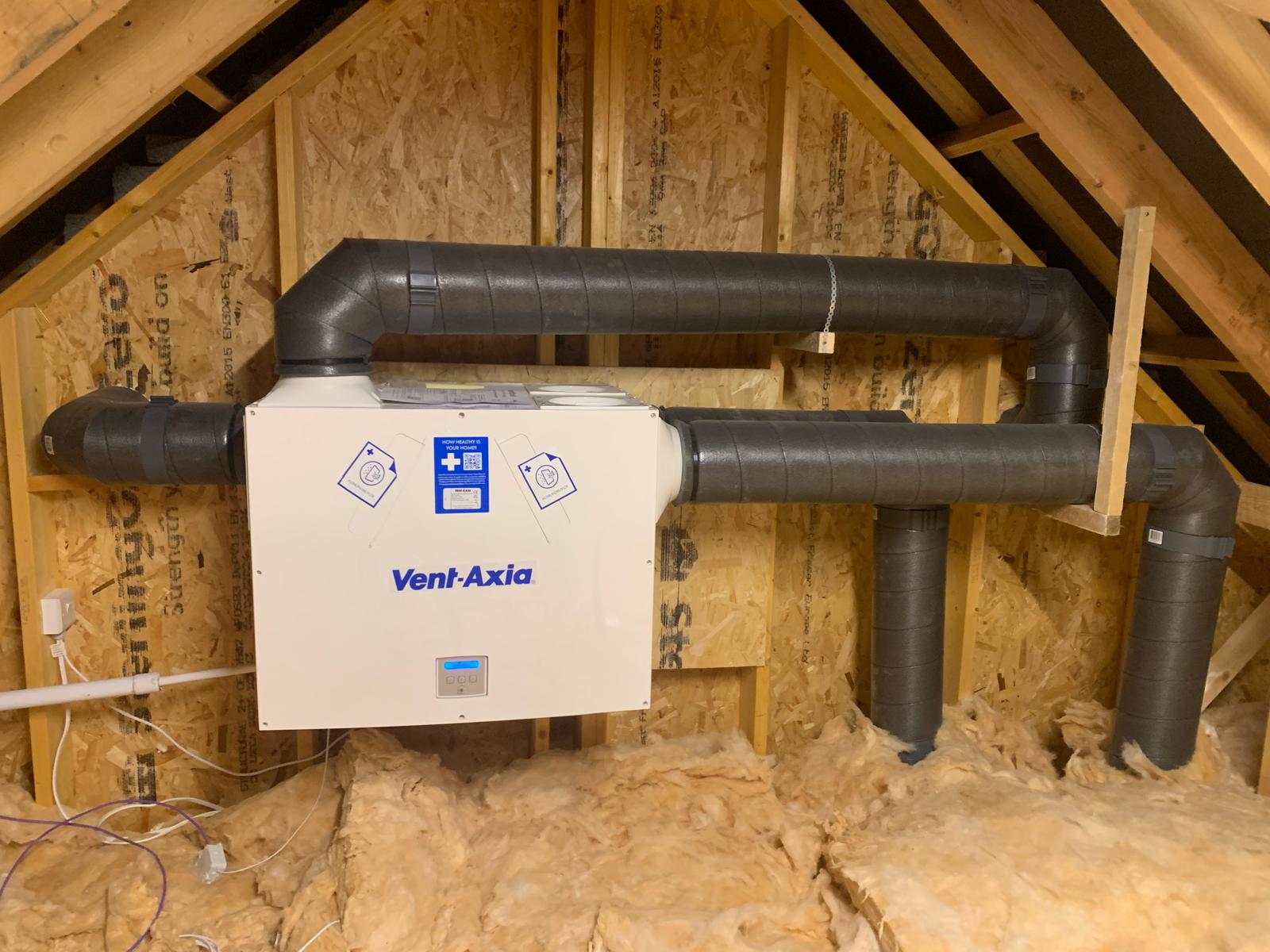
Heat recovery ventilation installation is more than fitting an MVHR unit. The distribution system, room airflows, workmanship and commissioning determine how the completed system operates. Healthy Homes provides design, supply, installation and commissioning as a coordinated service.
- 01
Design & airflow requirements
We plan supply and extract airflows for the rooms and layout, considering the property, ventilation requirements and system controls.
- 02
Unit selection & ductwork
The MVHR unit is selected for the required duty. Duct sizing and routing, manifolds where appropriate, insulation, supply and extract terminals and service access are incorporated into the design.
- 03
Supply & installation
The unit and distribution system are supplied and installed to the agreed specification, with attention to connections, outdoor intake and exhaust positions, and access for maintenance.
- 04
Balancing, commissioning & handover
Room airflows are measured and balanced, controls checked and the system commissioned. Homeowner handover covers operation, boost controls, filters and routine care.
How Much Does Heat Recovery Ventilation Cost?
The installed price depends on house size, required airflow, unit specification, duct routes and installation complexity. A quotation needs assessment of your plans or property and a clear scope of work.
See our 2026 guide to MVHR system costs in IrelandHeat Recovery Ventilation Maintenance
Inspect, clean or replace filters according to the manufacturer's instructions. Keep the unit and accessible terminals clear for routine inspection, and follow the operating guidance provided at handover. Filter condition and correct airflow matter for ongoing performance.
Unusual noise or reduced airflow should be investigated rather than ignored. Discuss MVHR maintenance with Healthy Homes.
Why Choose Healthy Homes for Heat Recovery Ventilation?
Healthy Homes is a Wexford-based Irish residential ventilation specialist providing system design, supply, installation and commissioning. We consider the property and proposed duct layout, not just the ventilation unit, and include balancing and homeowner handover in the installation process.
Whether you are planning a home or coordinating a building project, share the plans, location and construction stage so we can discuss a suitable approach and the scope of your quotation.
Talk to Healthy Homes About Your ProjectFrequently Asked Questions
What is heat recovery ventilation?
Heat recovery ventilation continuously supplies fresh filtered air and extracts stale, humid air from a home. A heat exchanger transfers heat from the outgoing air to the incoming air while keeping the two air streams separate.
Is heat recovery ventilation the same as MVHR?
MVHR stands for Mechanical Ventilation with Heat Recovery. In a whole-house residential system, the terms commonly describe the same balanced supply and extract ventilation approach. Decentralised room heat-recovery units are a different arrangement.
Does heat recovery ventilation heat your home?
A standard MVHR system recovers existing heat to temper incoming fresh air; it does not generate heat like a boiler or heat pump and does not replace the home's heating system. Performance depends on the design, airflow and indoor and outdoor conditions.
Does an MVHR system run continuously?
Yes. MVHR normally runs continuously at its commissioned background airflow, with boost operation when ventilation demand increases. Follow the controls and handover guidance rather than routinely switching the system off.
Is heat recovery ventilation suitable for an existing house?
It can be, but suitability depends on airtightness, building layout, space for the unit and access for duct routes. An assessment should consider installation disruption and compare alternative ventilation systems before specifying MVHR.
Does heat recovery ventilation help with condensation?
Controlled ventilation helps remove moisture from wet rooms and can reduce conditions that contribute to condensation. It is not a guarantee against condensation or mould: heating, insulation, thermal bridges, leaks and how the home is used also matter.
How much does a heat recovery ventilation system cost in Ireland?
The installed cost depends on the property's size, specification, duct routes and installation complexity. Our dedicated MVHR cost guide covers indicative supply and installation prices. A project-specific quotation requires assessment of the property.
See our 2026 guide to MVHR system costs in IrelandDoes an MVHR system need servicing?
Yes. Filters need inspection, cleaning or replacement as specified by the manufacturer, alongside routine checks of the unit and accessible terminals. Keep service access clear and investigate unusual noise or reduced airflow. Maintenance frequency depends on the system and local conditions.