
What Is MVHR and How Does It Work?
Understand how whole-house heat recovery ventilation works, what the unit and ductwork do, and whether it suits your home. Healthy Homes is an Irish ventilation specialist providing design, supply, installation and commissioning of residential ventilation systems.
What does MVHR stand for?
MVHR stands for Mechanical Ventilation with Heat Recovery. It is a whole-house ventilation system that continuously extracts stale, humid air from kitchens, bathrooms and utility rooms while supplying fresh filtered air to living rooms and bedrooms. A heat exchanger transfers heat from the outgoing air to the incoming fresh air without mixing the two air streams.
How does an MVHR system work?
Extract
The unit quietly pulls warm, moist air out of the wet rooms — kitchen, bathrooms, utility and WCs — through concealed ducting.
Recover the heat
Outgoing air passes through separate channels in a heat exchanger, transferring heat to incoming outdoor air without mixing the two streams. Performance depends on the unit and operating conditions.
Supply fresh air
Filtered fresh air, tempered by recovered heat, is delivered to bedrooms, living areas and home offices through supply ductwork and terminals.
Commission & balance
Airflows are measured and balanced room by room against the design requirements. Commissioning, control settings and a clear handover help deliver the intended ventilation.
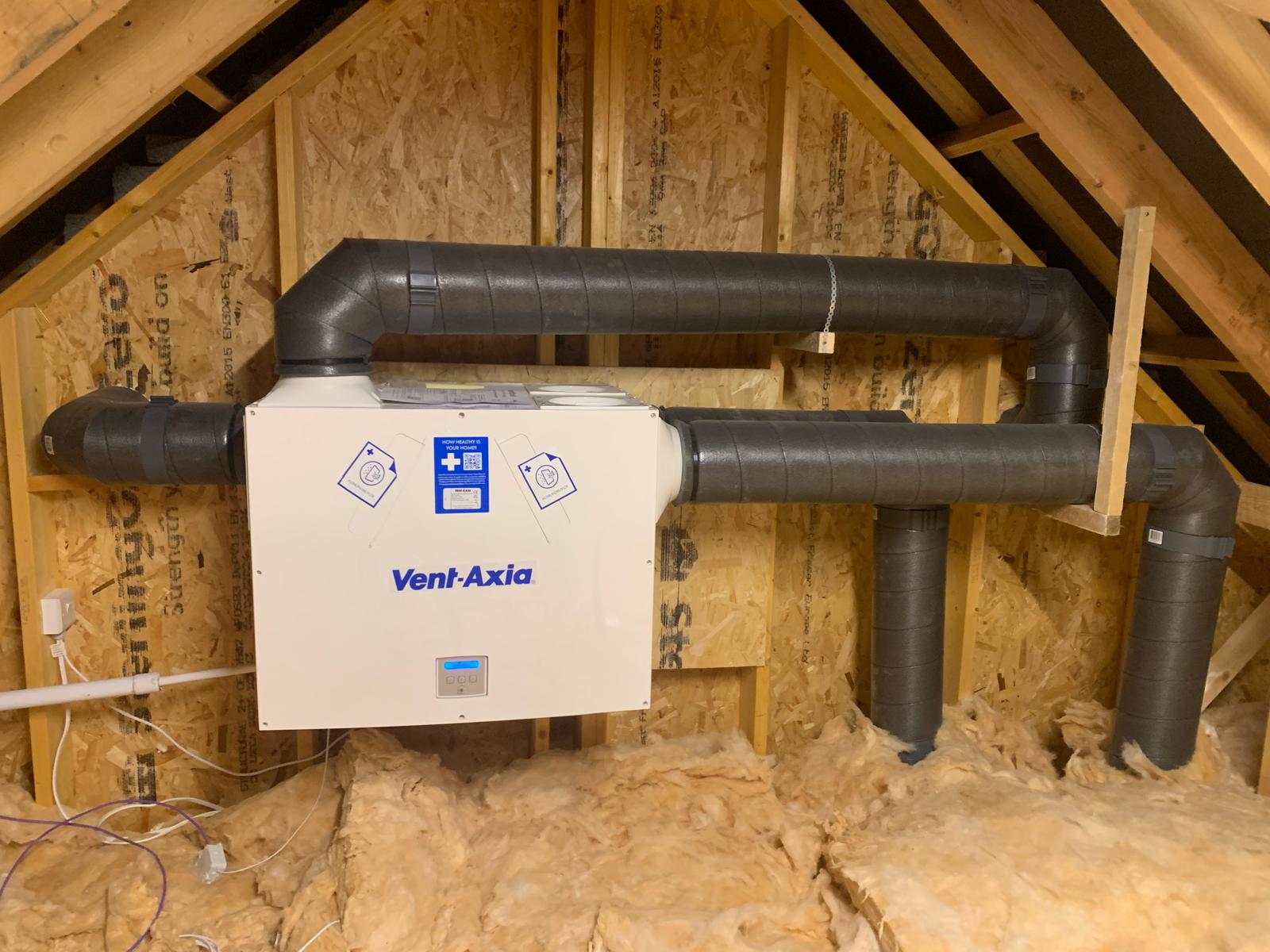
A Vent-Axia MVHR unit installed and commissioned in an attic by our Wexford team — see more in our ventilation installation case studies.
Fresh air supply
Outside fresh air
Outdoor intake
MVHR unit / heat exchanger
Filtered air receives recovered heat
Fresh filtered supply air
Supply ductwork
Bedrooms / living areas
Supply terminals
Stale air extract
Bathrooms / kitchen / utility
Extract terminals
Stale extract air
Extract ductwork
MVHR heat exchanger
Outgoing air transfers heat, not air
Exhaust outside
Separate outdoor exhaust
Heat passes across the exchanger between separate channels. The supply and extract air streams do not mix. Air moves between living areas and wet rooms through planned transfer paths, such as suitable door gaps. This schematic shows airflow, not a property-specific duct design.
How an MVHR heat exchanger works
Supply and extract air pass through separate channels. Heat transfers across the exchanger surfaces from the warmer stream to the cooler stream; stale air itself is exhausted outside. In cold weather this tempers incoming air. Performance varies with airflow, temperatures and the unit specification. A summer bypass, where fitted, reduces heat recovery when it is not wanted; it is not air conditioning.
What rooms does MVHR supply and extract from?
Supply terminals serve bedrooms, living rooms and other habitable spaces. Extract terminals serve bathrooms, WCs, kitchens and utility rooms. Planned transfer paths allow air to move between them. A kitchen MVHR terminal provides general ventilation; do not connect a grease-laden cooker hood directly to MVHR ductwork unless the system is specifically designed and approved for it.
Is MVHR suitable for Irish homes?
Airtight, well-insulated homes need a planned way to bring in fresh air and remove moisture, CO₂ and stale air. MVHR can suit homes where airtightness, duct space and installation access support a whole-house system. It is not automatically the best option for every Irish property.
The choice should account for ventilation requirements, layout, occupancy and the wider works. Part F ventilation requirements and energy performance must be considered as part of the design; fitting an MVHR unit alone does not establish compliance. Compare our residential ventilation system options before choosing a system.
MVHR in new builds
Plan MVHR before ceilings and walls close up. Agree unit location, duct routes, terminal positions, outdoor intake and exhaust placement, condensate drainage and service access with the design team. First-fix access makes it easier to integrate ductwork with the structure, insulation and airtightness strategy, including wider NZEB energy objectives.
Benefits of MVHR
Help control moisture
Continuous extraction removes humid air at source and can reduce condensation risk. Ventilation does not remedy leaks or every cause of mould.
Fresh, filtered air 24/7
Outdoor air is filtered before entering the home. Particle capture depends on the specified filter and its condition.
Keep the heat you paid for
Heat from extracted air tempers incoming fresh air, reducing ventilation heat losses in a suitable home.
Quiet, draught-free comfort
Correct duct sizing, suitable silencers and balanced airflow help keep ventilation quiet and comfortable.
Summer bypass
Where fitted, a summer bypass can reduce heat recovery when it is not wanted. It does not provide active cooling like air conditioning.
Measured performance
Commissioning and airflow reports record installed performance. Agree the required documentation as part of the quotation.
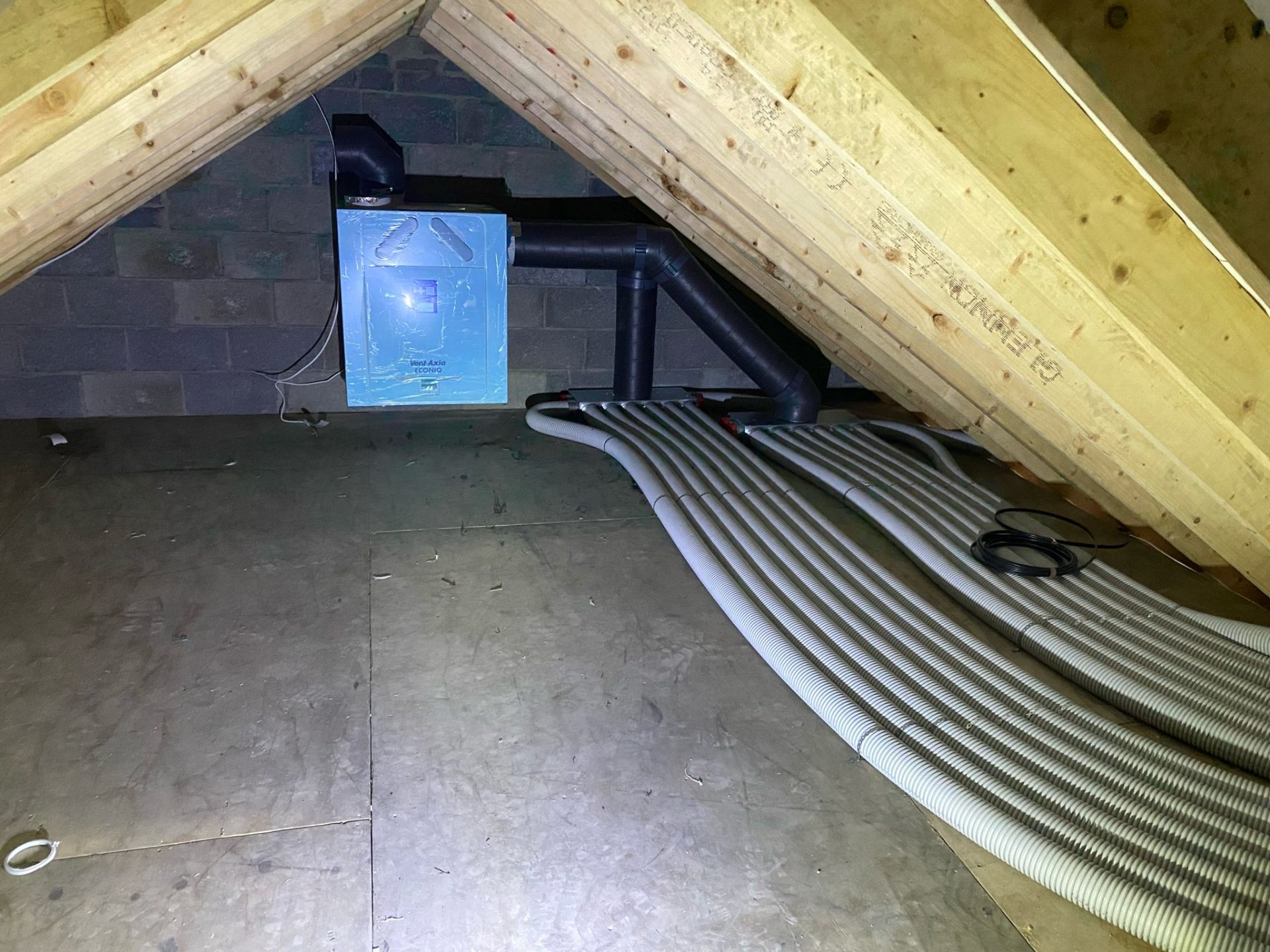
MVHR units and ducting
The unit contains fans, filters and the heat exchanger. Separate supply and extract ducts connect it to room terminals, sometimes through manifolds distributing individual runs. Outdoor intake and exhaust ducts are separate. A utility room, plant room or appropriate attic location needs space for filters, servicing and drainage. Where space is tight, ceiling-mounted or decentralised options may warrant assessment.
Design, installation, balancing and commissioning
Two homes can buy the same MVHR unit and have completely different experiences. What makes the difference:
- Design — duct routes, unit sizing and valve locations planned for your actual floor plan, not a template.
- Ductwork — correctly sized, sealed ducts, suitable silencers and insulation where required to control heat loss and condensation.
- Commissioning — every room's airflow measured and balanced, with the paperwork to prove it.
We're brand-independent — Vent-Axia, Zehnder, Aereco, Soler & Palau — so we specify the unit that suits your home, then commission it properly.
See our MVHR and ventilation installation photos for examples of units and ducts. Good duct sizing, suitable silencers and balancing help limit noise; unusual noise can also signal a maintenance or installation issue. Ask for measured airflows, boost settings and handover guidance, not just a fitted unit.
Can MVHR be retrofitted?
MVHR can be installed in an existing house where airtightness, layout and access allow suitable duct routes. Deep retrofit works can create an opportunity, but finished floors and ceilings may add cost and disruption. Assess suitability before assuming a unit will fit.
When another ventilation system may suit better
- Retrofits with limited disruption — demand-controlled ventilation (DCV) uses demand-responsive extract and planned fresh-air inlets; duct needs depend on the design.
- Apartments and smaller homes — continuous mechanical extract (cMEV) can be a compact alternative, subject to a suitable ventilation design.
- Older homes with damp issues — positive input ventilation (PIV) may help manage condensation in suitable homes; moisture sources and extract provision still need assessment.
- Extensions and stone-built homes — decentralised heat-recovery units go through an external wall, room by room.
Practical retrofit checks
Check airtightness, available duct routes and unit service access before choosing MVHR.
Agree boxing-in, electrical work and making good, plus balancing, commissioning and handover, in the quotation.
Does MVHR save energy?
Heat recovery reduces heat lost with extracted ventilation air. The benefit depends on airtightness, installed efficiency, airflow and indoor and outdoor temperatures. Fans also use electricity, so recovered heat is not a guaranteed reduction in total bills. Compare performance at the design airflow rather than treating a headline efficiency figure as a promise of household savings.
Heat recovery does not replace heating
A standard MVHR system reuses heat already in the home. It does not replace a boiler, heat pump or other appropriately designed heating system; its purpose is continuous ventilation with reduced ventilation heat losses.
MVHR maintenance and filters
Inspect, clean or replace filters according to the manufacturer's guidance. Frequency depends on the unit, filter specification and local conditions. Keep the unit and terminals accessible, and do not alter balanced valve positions during cleaning. Follow handover instructions for checks and servicing, and investigate unusual noise or reduced airflow rather than leaving it unresolved.
MVHR running costs
MVHR normally runs continuously at background airflow, boosting when needed. Fan electricity costs depend on power at the commissioned airflow, operating hours and your tariff. Budget for filters and servicing too. There is no fixed running cost for every home; our MVHR costs in Ireland guide explains how to assess running costs and compare installation quotations.
Frequently asked questions
What does MVHR stand for?
MVHR stands for Mechanical Ventilation with Heat Recovery. It supplies fresh filtered air and extracts stale, humid air while recovering heat from the outgoing air.
How does MVHR work?
Two fans move air through separate supply and extract ducts. Fresh outdoor air is filtered and supplied to bedrooms and living areas, while stale air is extracted from kitchens, bathrooms and utility rooms. Heat passes from outgoing air to incoming air in the heat exchanger without mixing the two streams.
Does MVHR heat your house?
MVHR recovers heat already present in extracted air to temper incoming fresh air. A standard MVHR system does not generate heat like a boiler or heat pump. Supply air temperature depends on indoor and outdoor conditions and system performance.
Does MVHR replace heating?
No. A standard MVHR system provides ventilation, not a replacement for heating. Heat recovery reduces ventilation heat losses, but the property still needs an appropriately designed heating solution.
Does MVHR run continuously?
Yes. MVHR normally runs continuously at its commissioned background airflow, with a boost setting for higher ventilation demand. Follow the controls and handover guidance rather than routinely switching it off.
Does MVHR need ducting?
Central whole-house MVHR needs separate supply and extract ducts connecting the unit to room terminals, plus outdoor intake and exhaust ducts. Duct sizing, routing, insulation where needed and service access must be planned. Decentralised room units are a different option where whole-house ducting is impractical.
Does an MVHR system need servicing?
Yes. Inspect, clean or replace filters according to the manufacturer's instructions and keep the unit and terminals accessible. Routine checks and servicing help maintain airflow and efficiency. Frequency depends on the unit and local conditions; investigate unusual noise or reduced airflow.
Can MVHR be installed in an existing house?
Yes, when the property's airtightness, layout and available space allow a suitable installation. Routing ducts through finished rooms can add disruption and cost. An assessment should compare MVHR with alternative ventilation options before work is agreed.
How much does an MVHR system cost in Ireland?
Installed prices depend on house size, specification, duct routes and installation complexity. Our MVHR costs in Ireland guide covers indicative prices and quotation inclusions. An accurate price requires assessment of your property.
See MVHR costs in IrelandPlanning an MVHR System? Talk to Healthy Homes
Send us your plans or a few details about the house. Healthy Homes can assess ventilation options and explain the design, supply, installation and commissioning scope for your property.