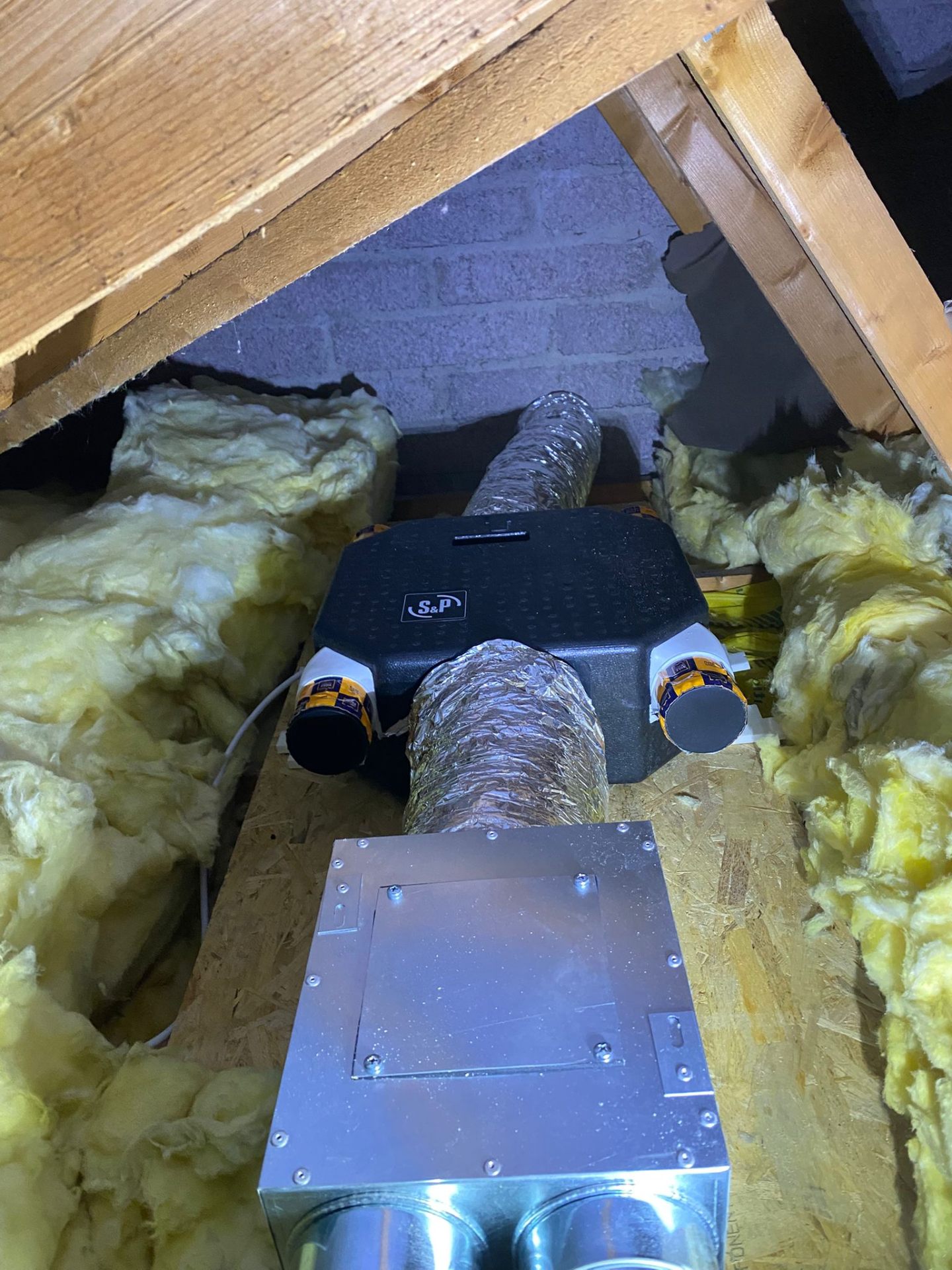
Residential ventilation ductwork installed between timber roof trusses in an Irish home
Residential ventilation solutions

Home Ventilation Systems Ireland

Not sure which ventilation system your home needs?

Every property is different. Healthy Homes provides home ventilation solutions based on the property, occupancy, existing ventilation and project requirements—from continuous extract and demand-controlled ventilation to whole-house heat recovery systems.

Talk to a Ventilation Specialist

Which Home Ventilation System Do I Need?

There is no single ventilation system that is best for every home. The appropriate solution depends on whether the property is a new build or existing home, its airtightness, size and layout, number and location of wet rooms, existing ventilation, occupancy, moisture or condensation issues, practical duct routes and project budget.

Healthy Homes can assess the ventilation requirements and recommend an appropriate approach. That may be MVHR, but another mechanical ventilation system can be a better fit for some properties.

Types of Home Ventilation Systems

01

MVHR — Mechanical Ventilation with Heat Recovery

MVHR continuously extracts stale, moist air from wet rooms and supplies filtered outdoor air to habitable rooms. A heat exchanger transfers warmth from the outgoing air to the incoming fresh air without mixing the two air streams. It is particularly suited to appropriately airtight homes and is commonly considered for new builds and suitable retrofit projects.

02

cMEV — Continuous Mechanical Extract Ventilation

cMEV uses a central fan to extract continuously from kitchens, bathrooms, utility rooms and WCs. Replacement air enters through appropriate air inlets or background ventilation provided as part of the system design, helping create a planned path for air through the home.

03

DCV — Demand-Controlled Ventilation

Demand-controlled ventilation adjusts ventilation according to demand, depending on how the system is designed. Humidity-sensitive components, for example, can increase ventilation when moisture rises rather than treating every room identically at all times.

04

Continuous / Decentralised Extract Ventilation

Individual continuous extract fans can suit certain properties or wet rooms where a centralised system is not practical. Each fan still needs to form part of a considered ventilation approach; one fan should not be assumed to meet the ventilation needs of an entire home.

Background Ventilation / Air Inlets

Replacement air is an essential part of extract ventilation. Removing air from a home without considering where replacement air comes from is not a complete ventilation strategy. Suitable inlets, transfer paths and any background ventilation should be considered alongside the extract system.

Home Ventilation System Comparison

SystemHow It WorksTypically Considered ForHeat Recovery
MVHRSeparate continuous supply and extract with a heat exchangerAppropriately airtight new builds and suitable retrofitsYes
cMEVCentral continuous extract from wet rooms with planned replacement airHomes where central extract ducting is practicalNo
DCVVentilation varies with demand according to the system designNew or existing homes suited to demand-led ventilationSystem dependent
Continuous / decentralised extractIndividual continuous fans extract from selected wet roomsProperties or rooms where central ducting may not be practicalNo

These are general comparisons. System selection should be based on the individual property and ventilation design.

Ventilation Systems for New Builds

Ventilation is best considered during design and construction rather than after the house is complete. The ventilation strategy, airflow requirements, unit location, duct routes, ceiling and joist coordination, room terminal positions and commissioning can then be planned before finishes close off access.

Ventilation Systems for Existing Homes

A retrofit needs to work with the existing building. Duct access, airtightness, layout and the problem being addressed all influence the options. MVHR is not automatically the correct retrofit solution; cMEV, DCV or decentralised systems may be more appropriate in some homes.

Ventilation for Condensation & Humidity Problems

Inadequate ventilation can contribute to elevated indoor humidity, condensation and recurring mould. These problems can also have other causes, including leaks, damp, thermal bridging, insulation or building defects, so ventilation does not solve every case.

Mould & Condensation Ventilation Solutions

From Ventilation Design to Commissioning

Healthy Homes is a Wexford-based ventilation specialist providing assessment, design, installation and commissioning for residential ventilation projects.

  1. 01

    Assess the Property

    Understand the house, occupancy, layout and existing or proposed ventilation.

  2. 02

    Select the Ventilation Strategy

    Determine which type of ventilation system is appropriate for the property and project.

  3. 03

    Design

    Consider required airflow, system layout, ducting or air paths and equipment selection.

  4. 04

    Installation

    Install the agreed ventilation system and its associated air paths or ductwork.

  5. 05

    Commissioning

    Set up and commission the system as appropriate so that it operates as designed.

See examples in our residential ventilation installation gallery and home ventilation case studies, or review the ventilation services we provide.

Why Professional Ventilation Design Matters

Selecting a fan or ventilation unit is not the same as designing a complete system. Correct airflow, suitable air paths, appropriate duct sizing and routing, practical terminal locations, noise considerations, balancing where applicable and commissioning all affect how the completed system operates.

A coordinated design also makes it easier to understand what is included before installation begins.

Demand-controlled residential ventilation equipment and insulated ductwork installed in a roof space

Planning a Home Ventilation System?

Whether you're building a new home, renovating or trying to improve ventilation in an existing property, Healthy Homes can help determine the most appropriate ventilation approach.

Request a Ventilation Quote

Frequently Asked Questions

What is the best ventilation system for a house?

There is no single best system for every house. The appropriate approach depends on whether the home is new or existing, its airtightness, size, layout, wet rooms, current ventilation, occupancy, moisture issues, available air and duct routes, and project budget. A property assessment helps establish which strategy is suitable.

What is the difference between MVHR and cMEV?

MVHR extracts stale air and supplies filtered outdoor air through separate duct systems, while transferring heat between the outgoing and incoming air streams. cMEV continuously extracts from wet rooms; replacement air enters through suitable air inlets or background ventilation included in the overall design. cMEV does not recover heat from the extracted air.

Do all homes need MVHR?

No. MVHR is particularly suited to appropriately airtight homes and is often considered for new builds and suitable retrofit projects. Depending on the property, cMEV, demand-controlled ventilation or decentralised extract may be a more practical approach.

Can a ventilation system help with condensation?

Appropriate ventilation can help manage indoor humidity where inadequate air change contributes to condensation. Condensation and mould can also be linked to leaks, damp, thermal bridging, insulation or other building defects, so ventilation is not a guaranteed cure for every property.

Mould & Condensation Ventilation Solutions

Can MVHR be installed in an existing house?

MVHR can be installed in some existing homes, but suitability depends on airtightness, layout, space for the unit and practical duct routes. Retrofitting can involve disruption, and another ventilation strategy may suit some properties better.

What is demand-controlled ventilation?

Demand-controlled ventilation adjusts airflow according to demand, depending on the system design. For example, humidity-sensitive components may increase ventilation when moisture levels rise rather than treating every room identically at all times.

Should a home ventilation system run continuously?

Many mechanical home ventilation systems are designed for continuous low-level operation, with increased airflow when needed. The correct operating pattern and controls depend on the selected system and its design, so homeowners should follow the commissioning and manufacturer guidance for their installation.

How much does a home ventilation system cost in Ireland?

Costs vary significantly according to the system type, property size, layout, equipment, air or duct routes and installation requirements. An accurate quotation requires a defined design and scope for the individual property.

See our guide to MVHR costs and pricing in Ireland